
Maxton Hall Season 2
Narrative intelligence for the entertainment industry

While teen dramas are often snubbed or derided by critics and experts, these cultural products serve as a vital scaffold for young girls navigating the difficult transition from childhood to adulthood.
It is understandable for cinema or literature enthusiasts to despise such IPs, but their function is not to lead the next frontiers of art; rather, it is to act as a mirror for a generation.
And sadly, there is definitely a shortage of good teen shows in this decade.
The global market is dominated by TV series adapted from Wattpad or BookTok phenomena, a strategically sound move, yet the transition from digital phenomenon to TV series always seems to stumble somewhere.
Culpa mía, Beautiful Disaster, After, My Life with the Walter Boys, Love me Love me, and so on. The list is growing, but they are mostly chaotic and difficult to complete, or, in many cases, to even begin.
In this landscape, Maxton Hall seemed like just another one; the neon-pink school uniforms are usually a bad sign, but, giving it a chance, it quickly shifts from background noise into a committed watch.
The show wasn’t a masterpiece, but it was good enough to become one of the leading teen dramas in production.
Maxton Hall Season 1
Maxton Hall's success came from its ability to capture the dramatic perspective of a teenager, effectively attracting its target audience, while remaining realistic enough to be taken seriously.
The female protagonist believed that being smart and doing well in school was enough to get into Oxford and lift her family out of poverty, but she is forced to confront the reality that her reputation and social skills are also essential, something she had actively avoided throughout high school, and now this threatens to ruin all she has worked for.
The male protagonist is the stereotypical rich kid. Rich characters are harder to write in general, since the higher the social status, the more complex and saturated the social codes become, but he is written well enough for the scope, certainly above average for the genre. The script and the actor are very good at portraying the childishness that often comes with growing up so sheltered, and the consequent childlike vulnerability that emerges once the rich, detached facade falls away.
Whereas in this genre, character decisions usually feel as if they were picked via a roulette wheel, in this drama, the characters act mostly coherently.
When the female lead is pulled aside by the male lead, who tries to intimidate her into accepting an absurd amount of money, she acts in accordance with the pure spirit she prides herself on and proudly rejects it.
The male lead attempts to appear more Machiavellian than he truly is, in a goofy attempt to emulate his father. Usually, this approach might work since, despite his goofy demeanor, people would realistically fear his father rather than him. However, this time, it doesn’t work.
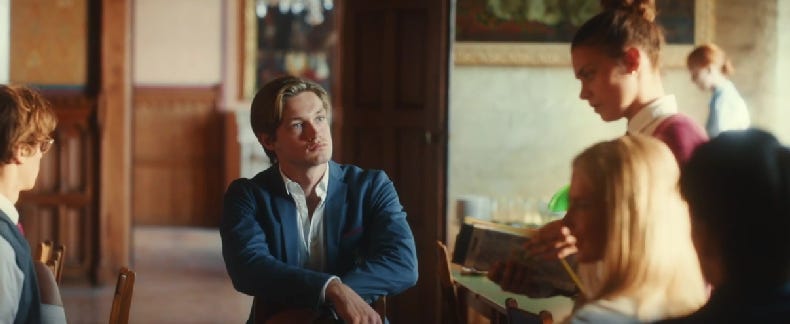
The female lead is not afraid of him or his father because she is not connected to him professionally or socially, and she is too young to understand the implications of her arrogant refusal or how his father could affect her life.
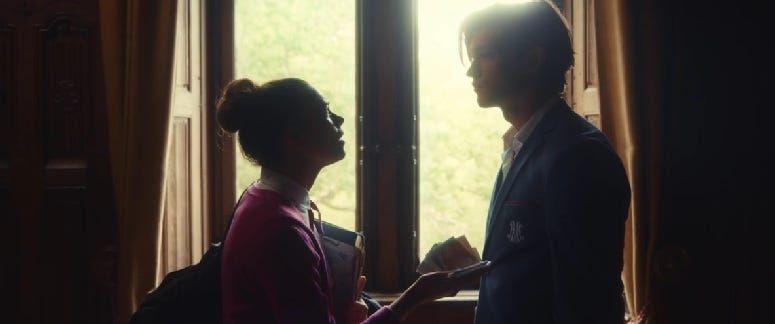
She attends this prestigious private school only thanks to a scholarship, and a big part of her personality is that she proudly keeps herself out of the dynamics of the elite who surround her.
So, she is totally untouched and unimpressed by the power play the male lead puts on because it belongs to a world she knows nothing about. He could ruin her life, but she underestimated its reach.

Neither character is perfect, a genius, or set to any impossible standard. They are both naive in their own, realistic way, just like any teenager at that age. This is why the audience sees themselves reflected in these characters.
The story progresses with a good alternation of slow buildup and payoffs.
The progression of the relationship from enemies to lovers between the two leads is mostly implicit, made of small gestures that yield some ground, until the canonical execution of the trope as the payoff.
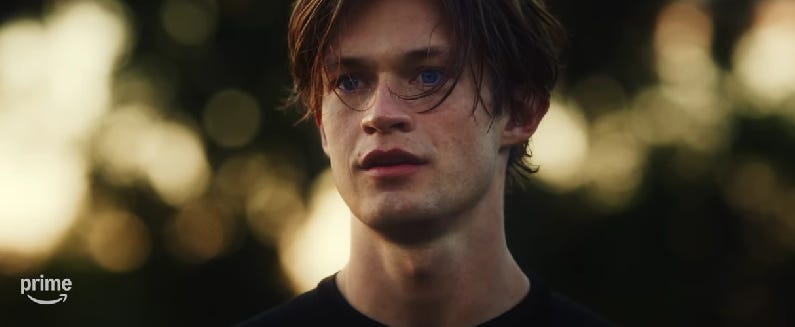
They dress up, and she walks down the staircase. They go to a party together when no one even knows they are friends. They arrive at school in the same car to formalize their relationship, and so on.
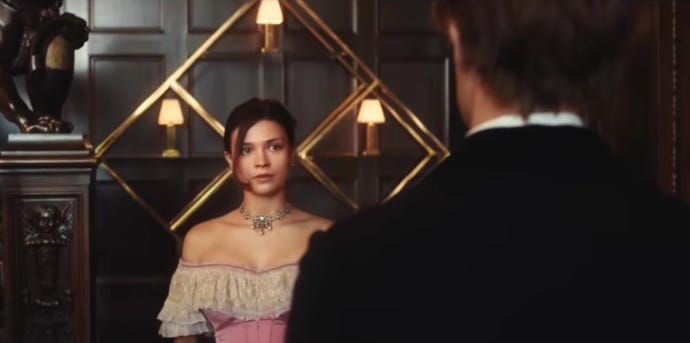
They employ most cliché tropes, but they work because the buildup to those moments is appropriately constructed.
The show has meaning, and that is exactly the point, and what most other shows don’t have or forget along the way.
It avoids the hollow spectacle of flipping cars without consequences, random deaths and subsequent resurrections, or secret twins coming out of nowhere, which dominate the market without any real substance.
Even in teen dramas, coherence, implications, and the unsaid are what keep the spectator glued to the screen to see where the story is going. Every frame and every line of dialogue must contribute something vital to the story, and Maxton Hall achieves this well.
The Telenovela Demon
Yet, in this era, no success is truly safe. There seems to be a direct correlation between a popularity breakout and a narrative downfall. Maxton Hall was not spared.
Season 1 ends on a precise, earned payoff: the leads officially get together after opening their hearts to each other and exposing their deep fears and fragility. The male lead then discovers his mother is dead. A genuine cliffhanger, and the audience is invested.
Season 2 opens with a weirdly ultra-edited, ultra-saturated repetition of a scene the audience has already seen, since it is set a few days earlier, given the show's storyline. something that should have been a warning, since after this the show enters what can only be described as a narrative freefall, and by the end of the first episode, it is clear that a “telenovela demon” has taken over. Nothing remains from the previous season.
Instead of a believable display of grief, the male lead’s response after his mother’s death is to attend a party, drink, use drugs, and surround himself with multiple women.
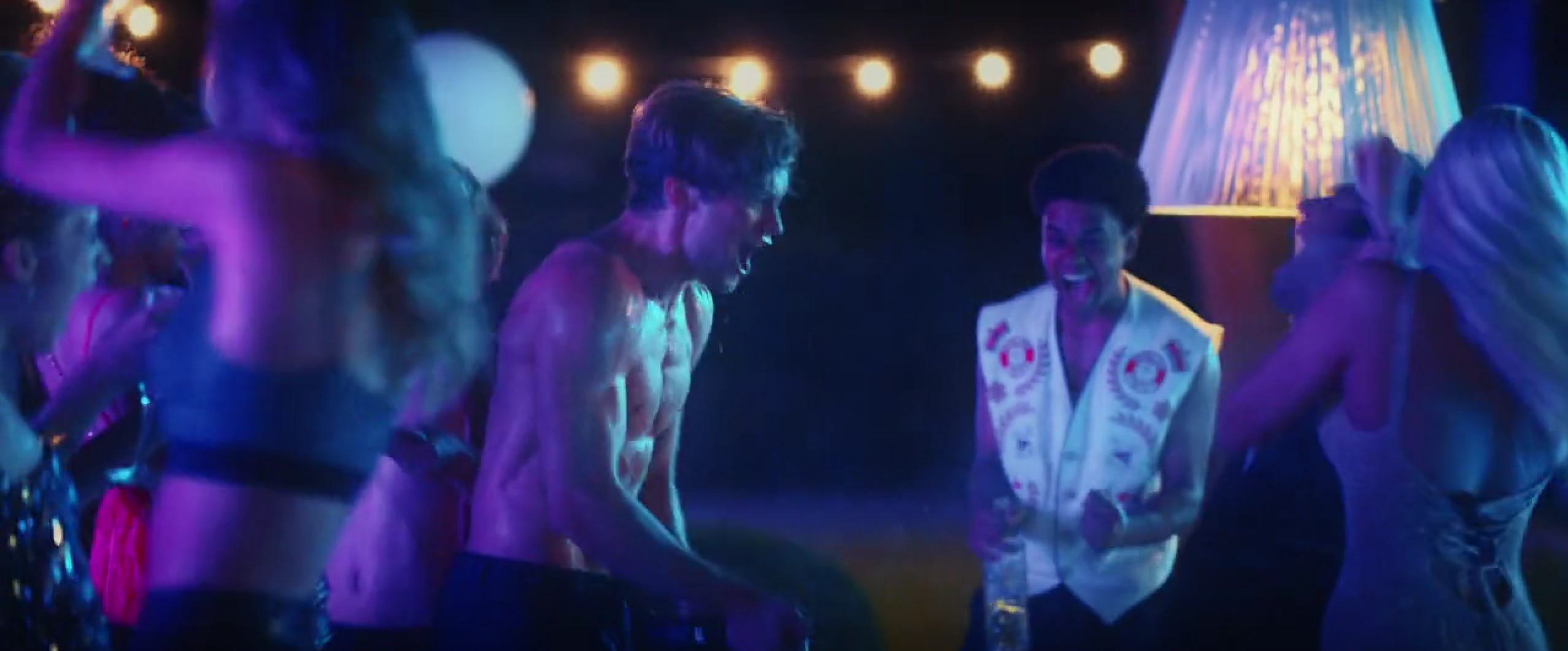
This is a jarring shift from the character we saw at the end of Season 1, a young man who believes he has found the love of his life. The show provides no psychological grounding for this turn.
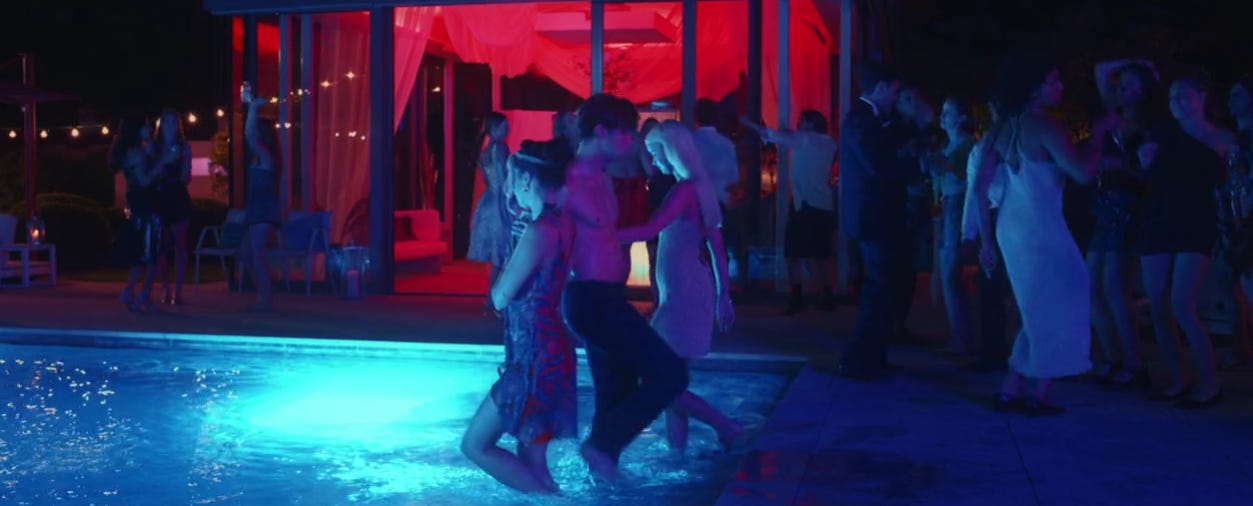
When the female lead tracks him down out of genuine concern, she is met with a devastating public humiliation. Maintaining direct eye contact with her, he allows three girls to drag him into the pool and lets one of them kiss him right before her eyes.

One of the girls mocks the female lead, weaponizing her deeply personal fear of water, a vulnerability she had previously shared with him, something he shows absolutely no reaction to, further amplifying her public humiliation.


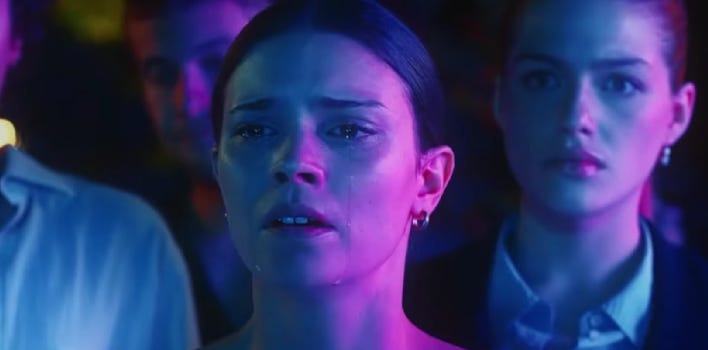
From a narrative and psychological standpoint, while there are infinite ways a character might manifest a trauma response, including the realistic urge to push a loved one away out of blind pain, this specific execution is jarringly unrealistic.
An altered state induced by drugs or alcohol is not a narrative get-out-of-jail-free card.
Even under extreme intoxication, people still operate within the framework of their core internal perspectives and emotional bonds. If the connection built throughout Season 1 was genuine, a realistic reaction to her sudden appearance in his delirious state would be a jolt of shock, a momentary piercing of the fog that would immediately halt the chaos around him.
Instead, the show chooses a path of active character assassination.

When the male lead sees her, he doesn’t panic, freeze, or break down. Instead, he becomes eerily calm. His reaction is not easy to pin down, but it’s as if he is at first surprised, briefly registers a forgotten memory, quickly evaluating the situation to conclude that she is just an inconvenience, or the enemy, actually, given his facial expression and the fact that everything he does seems aimed at maximizing the damage to her.
He calmly tells her to leave and then passionately kisses the other girl in front of her and all their friends, in the water, where “she can’t go.”
All of this comes across as extremely cold on his part, erasing the emotional stakes built in the entire previous season in a single, inexplicably apathetic stroke.

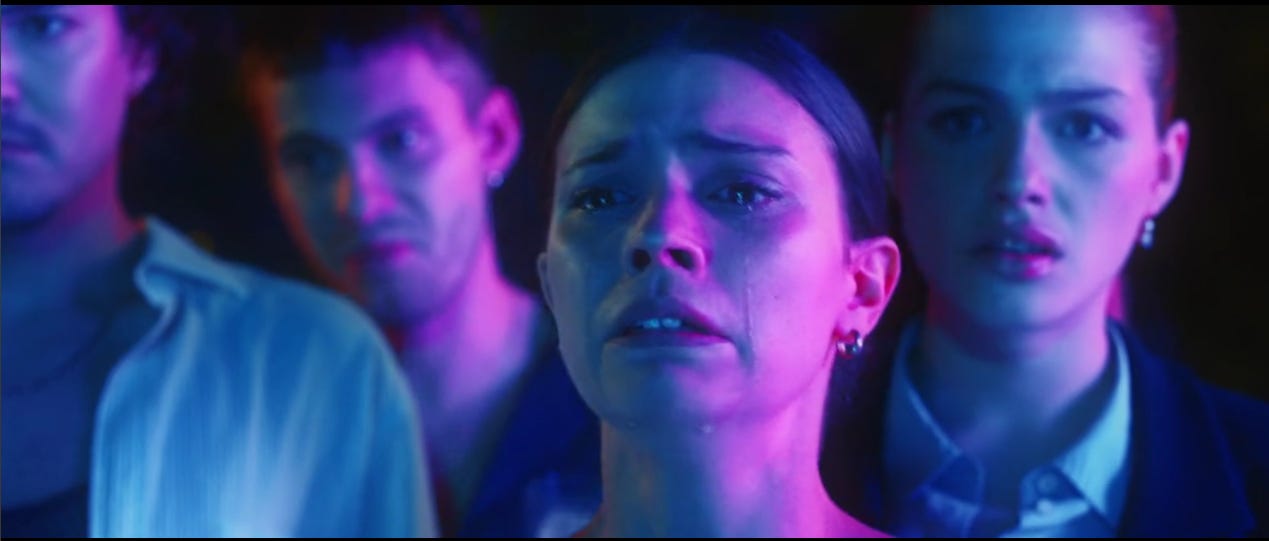
The key errors in this scene are the eye contact they share and the voluntary cheating.
A dramatic, even exaggerated but coherent, buildup could have been created by the showrunners in many ways; the partying, drinking, and even drug use are realistic trauma responses for a rich, spoiled teenager. But the way they framed the cheating is completely out of character for someone who should be madly in love.
It is not the cheating itself that is unrealistic, but the way it is framed here that comes off as totally arbitrary.
The show portrays someone who is keenly aware of what they are doing, so his behavior has no possible excuse.
There is absolutely no reason for this narrative choice; he doesn’t want to push her away for some mysterious reason that the show will reveal later.
So when the two meet the next day, the only explanation he can give is “I lost control,” a phrase that alone decapitated the franchise, marking the end of the IP's marketability and profitability.
I lost control
Claiming he “lost control” has a long and disruptive series of implications; it implies that remaining faithful required a monumental effort, an effort so exhausting that he couldn’t even sustain it for more than a couple of days. The inevitable implication is that he never loved her, and all that happened between them in Season 1 was just a sadistic joke on his part.
Or that he suffers from some severe case of mental illness since he changes personality so drastically and so suddenly.
The logic of this character is now so badly broken that the only way to realistically justify it within the show’s universe is if he were a literal monster, a clinical narcissist, or suffering from a severe psychiatric break, but since this is not the show’s intention, the character is now irrecoverable.
The unexplainable behavior of the male character cannot be fixed specifically because it is unexplainable. He cannot explain why he did it, understand why it was wrong, prove it will never happen again, or ask for forgiveness, because it has no reason or meaning.
One simple sentence was enough to ruin years of development, the entire dramatic buildup of the first season, and millions in investment.
“Telenovela demon” is the most appropriate analogy, since from this point on, the show introduces secret siblings and catastrophic car crashes that the characters miraculously walk away from unscathed.

The character choices become totally incoherent, and even once balanced characters become inexplicably sadistic, like the principal, who, out of nowhere, starts burdening the female lead with impossible missions, threatening to ruin her entire life if she doesn’t complete them.
The threshold of tolerable incoherence
A line like “I lost control” may not trigger a public outcry, but that doesn’t mean it is without consequence. When a narrative universe consistently contradicts itself in subtle, hard-to-identify ways, the audience, unable to properly verbalize the source of their discontent, will gradually and silently abandon the show. This is the central problem for the attention economy, for any brand, not only in entertainment: it makes it incredibly difficult to identify, fix, or avoid mistakes in the future.
A gradual abandonment fails to signal the exact moment of failure or the threshold of incoherence a spectator can tolerate. A viewer might watch a few more episodes out of mere inertia, or even finish the series just to see how it ends, but they do so completely disinvested. They will no longer engage in fandom behavior; they will not create, they will not advocate, and they certainly will not purchase.
In a data-driven market, this behavior is catastrophic precisely because it is invisible. Data analysts cannot determine exactly what went wrong, since the drop point isn’t necessarily related to the actual point where interest ended.
Data analysts can track when a viewer stops watching, but they cannot see the moment the viewer stops caring.
Many viewers cannot pinpoint or write down on a forum exactly why or how they were disappointed, usually offering brief, sometimes contradictory complaints.
This leaves the professionals completely blind to the rot at the core of their own IP.
Success in the teen drama genre requires more than just a high production budget and attractive leads. It requires a protective stance toward the Creative Vision.
Every detail, especially in pivotal trauma responses, must act as a brick in the wall of the character's integrity.
However superficial and frivolous these products may seem to an adult, they are not so to their audience, who, even if perhaps unwilling to admit it because of the stigma, watches them avidly and with great attention.
The Summer I Turned Pretty is a major example of this: despite the show’s controversial nature, by remaining true to itself and appointing the author as showrunner and creative director, it gained popularity at each release rather than declining as almost all teen dramas do, and is now probably one of the most successful teen dramas in recent years.
To truly earn the title of generation icon, the industry should start taking these stories as seriously as the girls who watch them do. Until then, the profit margins will remain low.
Contact me at: contact@silviabevilacqua.com